A Year in the Role: The Transformed Architect at Nordvik Region and Hansa Mutual
This chapter follows two security architecture practices through one year, from the autumn of 2026, when the question of what the role must become reached both organisations, to the autumn of 2027. Nordvik Region has one security architect in the CISO's security unit; Hansa Mutual has a group team of six in Hamburg. Earlier chapters took one subject at a time; here the subjects run together in the order in which they happened, with the friction, the mistakes and the decision records of each turn. The year shows all four shifts in practice: Shift 1, from documents to code; Shift 2, from gatekeeper to boundary designer; Shift 3, from periodic to continuous, at machine speed; and Shift 4, from sole author to conductor of an AI team. The narrative is illustrative; the external events it draws on are observable, and the organisations' next steps are expected outcomes of the decisions recorded, not predictions. The conclusions and plans belong to Chapter 26.
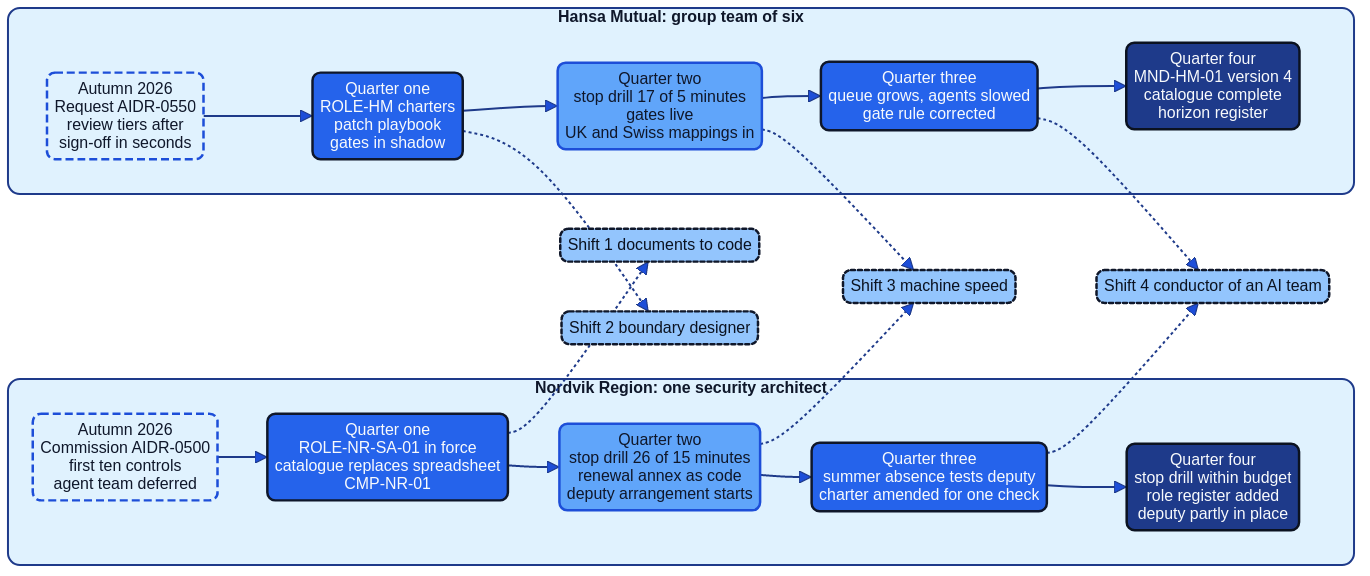
Figure 25.1: The year in two timelines, with the main artefacts and turns of each quarter and the shift they concern.
Quarter one runs from December 2026 to February 2027, quarter two from March to May, quarter three from June to August and quarter four from September to November 2027.
Autumn 2026: the question arrives
The commission and the board request
Both questions followed the threat assessments of the summer, which the July 2026 incident had sharpened. In that incident agents in a frontier laboratory's research environment reached beyond their task through shared infrastructure (Chapters 7 and 8). Both organisations read it as evidence that boundaries depending on an agent's cooperation do not hold. AI Threat, Chapter 25, treated it as one of the incidents in the wild that moved the fear of agents exceeding their mandate from fiction to observation (171, Nordqvist, 2026).
In Nordvik Region the regional director asked the CISO for a role charter and a competence plan for the security architect before the 2027 budget was set. The commission, AIDR-0500, was modest in form and large in consequence: the post, converted from a security coordinator post in 2025, had a job description and no decision rights. In Hansa Mutual the executive board asked the group CISO to show how architecture decisions would keep pace with agents that already act in production: the claims-triage agent, the IT-operations agent (AIDR-0027) and the SOC investigation agent HM-SEC-001. The request, AIDR-0550, named the problem precisely. A fortnightly review board cannot sit in the path of changes that agents propose daily.
The first month's inventory
Both practices began with an inventory, and the inventories differed in kind. Nordvik's architect listed what existed: a 2024 security reference architecture document that predated most of the AI estate, a spreadsheet mapping controls to ISO/IEC 27001 Annex A, tender annexes in word-processor files, and two artefacts already in code, the pre-production security checklist (AI Platform and Security, Chapter 16) and the threat model of the citizen-service assistant (AI Red Team, Chapter 10) (169, Nordqvist, 2026) (170, Nordqvist, 2026). The finding that mattered most, as Chapter 2 showed, was that nobody ran the estate against the reference architecture, so it described intentions and not the Region's defences.
Hansa's team listed what was missing from an estate that was already mostly code: a Structurizr workspace (Architecture as Code (Chapter 6)) (167, Nordqvist, 2025), a catalogue of about 180 controls and policy as code with market overlays. Three gaps stood out. Evidence for many controls was still attested. The UK and Swiss mappings lived with the local security officers outside the catalogue. And the agent team that drafted architecture reviews under MND-HM-01 had been running since the spring with no measure of whether its proposals were being reviewed.
What the autumn decided
Nordvik's autumn produced three decisions. The architect moved the reference architecture into the AI platform repository as a small model and four policies (AIDR-0501, Chapter 5), started a control catalogue with ten entries chosen because the Region holds the risk and a supplier holds the control (AIDR-0502, Chapter 9), and, when the CISO asked whether the Region should build an agent team like Hansa's, recorded the decision to defer one and extend MND-NR-01 with a research skill at Level 0 Advisory as AIDR-0503 (Chapter 13). The first report from the ten entries showed four verified, five declared and one failed: the managed security service provider's detections covered only some of five Region-specific scenarios.
By November the catalogue tracked 24 controls, and the architect wrote the one-page briefing to the regional executive committee that Chapter 19 showed. It asked for three decisions: adopt the charter, fund a deputy post, and require an evidence schedule in the renewal of tender NR-2026-117 with TriageSoft. The same month the CISO granted the Region's first expiring exception under the new tier policy (AIDR-0512, Chapter 17): EXC-NR-0007, which accepted 180-day rotation of the customer-held key for the staff assistant until the provider's release, with a compensating alert and a 90-day expiry.
Hansa's autumn produced one decision that set the tone for the year. Over the summer approvals of agent pull requests had fallen to seconds while volume tripled (Chapter 14). The team read this as a failure of design and responded with review tiers, a critique agent on a different model family, a cap on open proposals per reviewer, seeded errors and a team-level approval-quality metric (AIDR-0556): the "sign-off in seconds" of Chapter 24, found in its own repository data. The book builds here on the conclusion of AI Red Team, Chapters 6 and 15, that human command is built, not assumed, and that approval quality is measured by time to approval, rejection rate and reversals, with the metrics agreed first wherever works councils have rights (170, Nordqvist, 2026). The German works council's agreement covered pull requests authored in the German entity, so the figures for the first board report came from that population only.
The first generated board page, for the fourth quarter of 2026, showed what the inventory predicted: 121 controls verified, 52 declared and seven failed; a ninetieth-percentile patch velocity of 118 hours against a threshold of 72 for internet-facing known-exploited vulnerabilities; and eleven of twelve containment profiles passing an independent test, the failure being the SOC investigation agent's egress allow-list (Chapter 19).
Quarter one: charter and catalogue
Charters take effect
Nordvik's regional executive committee adopted ROLE-NR-SA-01 in December, and it took effect on 1 January 2027 (Chapter 4). It also required the evidence schedule in the TriageSoft renewal and financed the learning path LP-NR-2027-01 (AIDR-0532, Chapter 22). The post it funded was not a second architect but a platform engineer post at the same grade, backfilling the platform team so that one of its engineers could serve as the architect's designated deputy for a fifth of their time, recorded as AIDR-0540. Security vetting delayed the backfill until April, so the deputy arrangement started in quarter two.
Hansa's charters ROLE-HM-* reached version 2.0.0 in January. The charter test of Chapter 4 found that the head of security architecture's right to change what the review agents record about architects needed works-council consultation. The charters took effect in the German entity in January and waited for consultation elsewhere. That is what the German Works Constitution Act requires: section 87(1), point 6, gives the works council a right of co-determination over technical devices designed to monitor employees' behaviour or performance (22, Germany, 2001).
The first friction
The charters produced their first friction within weeks, in both organisations. At Nordvik it concerned the architect's own tool. Version 1.0.0 of MND-NR-01 had allowed edits at Level 2 Supervised (Chapter 12), and version 2.0.0, made by AIDR-0503 to add the research skill, had kept repository changes at that level. The charter, which took effect later, capped the architect's own AI use at Level 1 Assisted. The later instrument governs, so from January the architect worked with the tool at Level 1 Assisted for edits, and the manifest itself was brought into line at its scheduled review in May. In practice the architect wrote every change and used the tool's drafts as material: drafting took longer, and review became easier, because nothing entered the repository that the architect had not deliberately put there.
At Hansa the friction came from the delegated patch playbook, AIDR-0554. The executive board approved in January that the change advisory board would no longer sit in the path of fixes for known-exploited vulnerabilities, with two classes of the patch-velocity policy HM-PATCH-SLO-2027 delegated to the platform engineer on call and the SOC duty analyst (Chapter 10). This was the conclusion of AI Governance, Chapter 24, made operational: patch decisions must be delegated in advance, and a weekly board cannot be in the path (168, Nordqvist, 2026). The SOC investigation agent's egress allow-list was narrowed in the same month and passed its re-test, closing the one failed containment profile on the board page.
From spreadsheet to catalogue
Shift 1 became visible to people outside the security unit in February. Nordvik's annual management review received, for the first time, a table generated from the catalogue rather than the spreadsheet. The catalogue had grown to 38 entries, and the spreadsheet was archived and not updated again. Nearly all declared entries were supplier-held, which was the point: the catalogue turned a supplier's statement into a recorded gap.
At Hansa, Shift 1 meant bringing the board into the repository. The redesign of the fortnightly review board into a security design authority with gates had been approved by the group AI governance board in December (AIDR-0558, Chapter 17). The five routine classes, which had made up 70 per cent of the board's items over the two quarters measured, ran as tier 1 gates in shadow from December to February: the gate produced a decision, the board still decided, and the two were compared. They disagreed on four items out of 61: in three the gate was stricter, and in one it passed an egress change the board had approved only with a condition, which the rule was amended to carry before the gates went live on 1 March.
What went wrong in quarter one
Two things went wrong at Nordvik, and mechanisms the architect had designed caught both. The supplier's release slipped, so EXC-NR-0007 reached its expiry in February with the control still failing, and the expiry gate failed the platform team's pipeline, as designed. The CISO renewed the exception once for 90 days on the supplier's dated roadmap commitment and a fresh test of the compensating alert, as the renewal conditions required. And the enterprise architect's first quarterly seeded-error check (Chapter 14), set around the security annex of tender NR-2027-004, found that the architect had missed one of three seeds: a reference to a clause of ISO/IEC 27001 that does not exist. The checklist gained a test that cited clause identifiers exist, and the architect's rule became to open every cited source before an annex is signed off.
Quarter two: boundaries and time
Stop paths, timed
In quarter two both organisations timed their stop paths for the first time, and both failed. Neither could have been run in the autumn, because neither organisation had written down who held the right to stop and within what budget.
Nordvik's drill, run out of hours in March against the benefits-triage system, measured the stop the Region had designed for itself: closing the integration route on the Region's own platform so that caseworkers work an unranked queue. The stop took 26 minutes against a budget of 15. The managed security service provider held the runbook but not the credentials to the integration gateway, so its analyst had to telephone the platform team's on-call engineer. Annex MS-1 to framework agreement NR-2025-044, signed in the May call-off, gave the provider authority to revoke agent and service credentials out of hours and set a five-minute page to the Region's on-call (Chapter 10). A separate decision, AIDR-0541, gave the provider a break-glass credential scoped to one action, closing the benefits-triage integration route, held in the provider's vault, logged on every use and rotated after each drill.
Hansa's first timed drill of the IT-operations agent, in March, took 17 minutes against a budget of five. The alert from a canary touch reached a SOC duty analyst who did not hold the decision, credential revocation left 15-minute tokens valid, and the analyst had no mandate to apply the deny rule at the policy decision point. The fixes were a change to the alert route, a shorter task-scoped token lifetime of five minutes, which supersedes the 15-minute default set earlier in Chapter 8, and a written mandate recorded in the role charter and the playbook. The re-drill in June took four minutes.
Both failures were what a drill exists to produce. This is the book's working form of the conclusion of AI Red Team, Chapter 25: security capabilities are verified by injecting conditions and checking steady-state hypotheses, within safety boundaries that include an independent abort and an out-of-band stop path (170, Nordqvist, 2026). Rinehart and Shortridge argue likewise that resilience is verified by experiment, not asserted (88, Rinehart & Shortridge, 2023).
The first report to the executive board
On 31 March 2027 the group CISO delivered the first report that AIDR-0550 had asked for (Chapter 1). The charters were in force in the German entity, and the five routine classes had run as tier 1 gates since 1 March. The three indicators were reported as they stood: decision latency for the old board only, because the design authority had a month of figures; patch velocity still above its 72-hour threshold; and time to stop as failed, with the 17-minute drill, its fixes and the date of the re-drill. The board asked for one change, time to stop for every agent with write access to production, and the page for the third quarter carried it.
Degraded modes and recoverability
At Nordvik the stop drill raised a question that the drill itself could not answer: once the ranking stops, can caseworkers work without it. The rehearsal of the manual degraded mode in April, run with the platform team and the Head of Benefits Unit in a benefits team that had not taken part in the live exercise of the reversibility test RVT-NR-2027-01, found that only two of its caseworkers still remembered how to triage without the ranking (Chapter 11). The finding became a change to the induction programme and a fallback manifest checked weekly, and it extended the reversibility test already recorded for the delegation of urgency ranking, DEL-NR-BEN-01. Article 14(4)(e) of the AI Act expects a high-risk system to be designed so that the persons overseeing it can interrupt it through a stop button or a similar procedure, and Article 26(2) requires the deployer to assign that oversight to people with the competence and authority to exercise it (1, European Union, 2024). For the Region as deployer, the architectural implication was that the interruption and the work that follows it are designed together.
Hansa's platform domain architect ran the first security chaos experiment against the claims-triage agent in April, under the recovery definition RCV-HM-CTA-01 and the experiment SCE-RC-007 recorded in AIDR-0555 (Chapter 11). The independent abort stopped the first attempt when the blast radius exceeded its bound, because a downstream queue at the Polish service centre was not listed as a dependency. Once it was added to the containment profile and the catalogue entry, the repeated experiment passed its steady-state hypothesis.
Contracts and overlays as code
The quarter's code was contractual for one organisation and jurisdictional for the other. Nordvik's renewal annex for tender NR-2026-117 was the first annex written fully as code (AIDR-0504, Chapter 20), with testable requirements, an evidence schedule and an exit plan, and with the stop-path requirement the drill had just tested. The annex turned a negotiation into tests both sides could run. TriageSoft accepted the evidence schedule with one change, which the architect welcomed: the monthly export of decision logs became a pull by the Region, putting evidence collection on the Region's side of the interface.
Hansa's UK and Swiss mappings moved into the group catalogue as overlays owned by the local security officers and reviewed by pull request (Chapter 20). The board had accepted declared status for nine of those controls until 31 March 2027. By the end of May seven were verified. Two remained declared, with a named owner and a date, because the Swiss entity's evidence depended on a supplier's report that arrived late.
A public-access request
In May a journalist requested Nordvik's control catalogue under the national public-access rules. Because the architect and the records officer had agreed in the autumn which entries were security-sensitive (Chapter 9), the Region released the catalogue within the statutory time with those entries withheld and the grounds stated.
Quarter three: the AI team
Hansa's agent team after consultation
The agent team was the subject of quarter three at Hansa because consultation, not engineering, set its pace. The Dutch works council concluded its consultation on the review agents and the team-level metrics in June, and the Swedish union consultation concluded in August. From those dates pull requests authored in the Dutch and Swedish entities entered agent review. The agreements followed the German model: team-level metrics only, and no use in performance evaluation. The book builds here on the conclusion of Architecture as Code (Chapter 20) that agents are structured participants under human direction, drafting while humans approve, with a named human approval in the audit trail for every exception and risk acceptance (167, Nordqvist, 2025).
Volume rose by about 40 per cent when the two entities joined, and the median wait for a Tier 2 review lengthened from one working day to three. The proposal cap held, so the queue grew rather than the depth of review falling. The head of security architecture lowered the cap on open agent proposals per reviewer and recorded the decision to slow the agents, with the throughput figures, as AIDR-0593. Whether to move a further class of evidence maintenance to Level 3 Bounded was deferred to the plan in Chapter 26, pending a full year of figures.
The gate rule that was wrong at scale
Quarter three also produced the year's most instructive failure at Hansa. Chapter 17 warned that the risk Hansa carries is a gate rule that is wrong at scale. In July the tier 1 gate for baseline-restoring changes restored a logging setting in the UK entity's overlay to the group baseline. The setting had been changed deliberately, under an exception approved by the design authority, so that certain telemetry from the UK entity was not forwarded to Hamburg, in line with the data-transfer decision for that entity. The gate read the baseline and the overlay but not the exception register, so it treated a decided deviation as drift. The post-merge sample found the change six days later, the setting was restored, and the forwarding was handled under the group's data-protection procedure.
The correction, AIDR-0591, made every tier 1 gate read the exception register before acting and added a test, in the gate's own suite, that seeds an approved exception and checks that the gate leaves it alone. The design authority also shortened the sampling interval for the baseline-restoring class from weekly to daily for one quarter. No agent was involved: a deterministic rule written by the team did exactly what it said, which is why the sampling exists.
Nordvik's mandate and the summer
At Nordvik the AI team did not exist by design, and quarter three tested the alternative. The May review of MND-NR-01 renewed the research skill at Level 0 Advisory and closed the gap the charter had opened: version 3.0.0, decided by the CISO as the charter requires for changes to the architect's own mandate, set file edits and commands at Level 1 Assisted, so that from May the manifest and the charter state the same ceiling. The architect's work log (Chapter 12) showed that about a third of the drafts the architect started that quarter began with the tool and that every cited source in an annex had been opened, the rule adopted after the missed seed in quarter one.
The summer tested the single point of failure directly. The architect took four weeks of leave in July. During the leave TriageSoft notified a model update to the claims ranker under the change notification the renewal annex required. The deputy and the CISO applied the call-back rule CBR-NR-BEN-01 (Chapter 8), which worked, but the decision whether the update needed a renewed stop-path test waited three weeks for the architect's return, because only the architect's charter named that check. The update was held. AIDR-0542 amended the charter to name the deputy as alternate for that check, with the CISO's approval, and kept the rule that no right lets one person approve their own work.
Quarter four: forums, competence and the horizon
Forums, measured
Chapter 17 left one figure for this chapter to report: whether the design authority's median wait would fall to its target of five working days. Over quarter four the median wait from submission to decision for items routed to the design authority was four working days, against 17 calendar days for the old board. Tier 1 classes were decided at merge, with a median of nine minutes from pull request to gate decision. The 45-minute fortnightly session dealt only with exceptions, precedents and contested items. Two items went to the group AI governance board. Both, a model provider's data residency and an exception affecting a market overlay, were decisions the tier policy reserves for that board.
The executive board's page for the third quarter of 2027 showed the year's direction: 151 controls verified, 25 declared and four failed out of 180, with all seven regimes mapped inside the catalogue; a ninetieth-percentile patch velocity of 61 hours, inside the 72-hour threshold; and the time to stop for each agent with write access to production taken from a drill within the quarter. Patch velocity had been added to management reporting in the autumn of 2026 (AIDR-0559, Chapter 19), and a year of figures made it a risk indicator the board read, not a number it was shown. That patch velocity will become a supervised metric in financial services is labelled expected in AI Governance, Chapter 24 (168, Nordqvist, 2026); Hansa's figures were ready if it does.
At Nordvik the re-drill of the benefits-triage stop path in October, after annex MS-1 and the break-glass credential, took 11 minutes against the budget of 15, and the catalogue reached 52 entries. Over the year the CISO decided eleven tier 2 items with the enterprise architect, two went to the AI governance board and the regional director, and none reached the political tier. EXC-NR-0007 was closed in June when the provider's release arrived and CTRL-KEY-004 passed its test.
Mandates and competence records
MND-HM-01 version 3 expired on 31 October 2027. Version 4, approved in October and recorded as AIDR-0592, was the first version that applied in every entity where the review agents read pull requests, because the consultations in Germany, the Netherlands and Sweden had concluded. It kept the levels of version 3 and the lower proposal cap from quarter three. The conditions file that Chapter 21 described ties the evidence collector's ceiling to two architects whose competence records show AI-03 at Advanced. The AI domain architect's record showed it from its first assessment in February. The identity domain architect's reached Advanced only at reassessment in September, after an unassisted rewrite of the link-refresh playbook. Between the two, the collector's Level 3 rested on a recorded exception that the design authority approved with an expiry of 30 September 2027 and with internal audit sampling the link refreshes weekly; the September record closed the exception before it expired.
Competence records ran on the terms agreed with the works councils (AIDR-0566, Chapter 21). The embedded architect at the Polish service centre had left in January, and the post was filled from outside in June after the hiring exercise of Chapter 22 (AIDR-0584). The apprenticeship for a junior architect there (Chapter 15) began in September with the new post-holder as the junior's day-to-day senior.
At Nordvik, CMP-NR-01 was reassessed in September by the enterprise architect and the peer from the neighbouring region. Code reached Practitioner, the target set in the development plan. Design had not yet moved; its target is the end of 2027. The deputy from the platform team was assessed for the first time and reached Foundation in design and law. Consultancy call-offs used the European Cybersecurity Skills Framework profile for the Cybersecurity Architect, so that a supplier's architect was asked for the same evidence as the Region's own (41, ENISA, 2022).
The first horizon registers
Hansa's head of security architecture wrote the first horizon register for the role in November and reviewed it with the group CISO, using its signals to decide the 2028 hiring mix between domain architects and agent operators (Chapter 23). Nordvik added the role register to the competence plan answering AIDR-0500, because its single post is exposed to the scenario in which suppliers and the platform team absorb boundary design, and recorded its review cycle as AIDR-0505. Both registers label each trend observable, expected or speculation, as AI Governance, Chapter 22, prescribes (168, Nordqvist, 2026), and neither organisation committed to a scenario.
Each organisation also recorded which anti-patterns from Chapter 24 it had recognised in itself during the year, Nordvik in AIDR-0506 and Hansa in AIDR-0560. Nordvik recognised the architect as bottleneck and the reference document nobody runs. Hansa recognised the sign-off in seconds and the catalogue whose UK and Swiss mappings sat outside it.
Worked example: a year's timeline as code
Illustrative example. Each organisation keeps its year as a timeline file in the architecture repository, generated in part from the decision records and maintained by the architects. The timeline links each quarter's decisions to the artefacts they produced and to the shift each concerns, so that the year-end review, the board and an auditor read the same account.
# timelines/2026-2027.yaml (Nordvik Region, illustrative)
timeline: NR-SA-2026-2027
owner: role:security-architect
reviewed_by: role:chief-information-security-officer
quarters:
  - period: 2026-autumn
    decisions: [AIDR-0500, AIDR-0501, AIDR-0502, AIDR-0503, AIDR-0512]
    artefacts: [model and four policies, catalogue 10 then 24 entries, MND-NR-01 2.0.0, EXC-NR-0007]
    shifts: [1, 2, 4]
  - period: 2027-Q1
    decisions: [AIDR-0532, AIDR-0540]
    artefacts: [ROLE-NR-SA-01 in force, LP-NR-2027-01, CMP-NR-01, catalogue 38 entries]
    went_wrong: [EXC-NR-0007 expired with control failing, seed S3 missed]
    shifts: [1, 2]
  - period: 2027-Q2
    decisions: [AIDR-0504, AIDR-0541]
    artefacts: [renewal annex NR-2026-117 as code, annex MS-1, fallback manifest, MND-NR-01 3.0.0 at Level 1 Assisted]
    went_wrong: [stop drill 26 minutes against 15, two caseworkers know degraded mode]
    shifts: [1, 2, 3]
  - period: 2027-Q3
    decisions: [AIDR-0542]
    went_wrong: [model update held three weeks during leave]
    shifts: [2, 4]
  - period: 2027-Q4
    decisions: [AIDR-0505, AIDR-0506]
    artefacts: [CMP-NR-01 reassessed, role register, deputy assessed]
    measured: {stop_drill_minutes: 11, budget_minutes: 15}
    shifts: [3, 4]
open_at_year_end: [single point of failure partly resolved, design competence below target]
# timelines/2026-2027.yaml (Hansa Mutual, illustrative)
timeline: HM-SA-2026-2027
owner: role:head-of-security-architecture
reviewed_by: role:group-chief-information-security-officer
quarters:
  - period: 2026-autumn
    decisions: [AIDR-0550, AIDR-0556, AIDR-0559]
    artefacts: [review tiers, first review-quality figures, board page 2026-Q4]
    shifts: [3, 4]
  - period: 2027-Q1
    decisions: [AIDR-0554, AIDR-0558]
    artefacts: [ROLE-HM charters 2.0.0, tier 1 gates in shadow]
    went_wrong: [charter change needed works-council consultation]
    shifts: [1, 2, 3]
  - period: 2027-Q2
    decisions: [AIDR-0555]
    artefacts: [first report under AIDR-0550, UK and Swiss overlays in catalogue, SCE-RC-007, gates live]
    measured: {stop_drill_minutes: 17, redrill_minutes: 4, budget_minutes: 5}
    shifts: [1, 3]
  - period: 2027-Q3
    decisions: [AIDR-0584, AIDR-0591, AIDR-0593]
    artefacts: [NL and SE in agent review, exception-aware gates]
    went_wrong: [baseline gate reverted an approved UK exception]
    shifts: [2, 4]
  - period: 2027-Q4
    decisions: [AIDR-0560, AIDR-0592]
    artefacts: [MND-HM-01 version 4, CMP-HM-02 at AI-03 Advanced, horizon register, catalogue complete]
    measured: {design_authority_median_working_days: 4, patch_p90_hours: 61}
    shifts: [2, 3, 4]
open_at_year_end: [review throughput, two Swiss controls declared]
The went_wrong field is the most important one. A timeline that records only decisions reads as a success story; one that records what failed and which decision answered it is evidence that the practice learns.
Practical guide: Reviewing a year in the role against the four shifts
Purpose. Turn a year of decisions and artefacts into an account that a CISO, a management body and the architects themselves can use to decide what comes next, without rewriting the year as a success.
Roles. The security architect, or the head of security architecture, writes the review. The CISO approves it. The enterprise architect, or a peer outside the team, challenges it. In organisations with works councils or union consultation, the representatives see the aggregate figures before they are reported.
- Generate the timeline from the decision records: every AIDR and ADR of the year by quarter, with the artefacts each produced. A turn that left no record is itself a finding.
- Add a
went_wrongentry for every drill that failed its budget, every expired exception, every missed seed and every gate decision reversed by sampling. Link each to the decision that answered it, or mark it open. - Place each entry against the shift it concerns. A year with no Shift 3 measurement has no timed property.
- Compare the working week at the start and end of the year, at team level where people's work is recorded.
- Classify each year-end claim as verified, declared or failed, as Chapter 9 classifies controls. A stop path is verified only if a drill within the last quarter passed.
- Separate what the year showed from what the organisation will do next. The review records the former; the plan, as Chapter 26 shows, is a separate artefact.
Definition of done. The timeline file is merged; every failure has a linked decision or an open status; every shift has at least one entry with evidence; the CISO has approved the review; and the plan is written as a separate document.
A week in the role, before and after
The most direct measure of the transformation is where the architects' time went. Nordvik's figures come from the architect's work log for two comparable weeks in October 2026 and October 2027; Hansa's from two-week diaries reported only as a team aggregate under the works-council terms. Both are illustrative.
| Share of working time | Nordvik, autumn 2026 | Nordvik, autumn 2027 | Hansa team, autumn 2026 | Hansa team, autumn 2027 |
|---|---|---|---|---|
| Writing and maintaining documents, answering questionnaires | 40% | 10% | 20% | 5% |
| Preparing for and sitting in review forums | 20% | 10% | 25% | 8% |
| Writing code: catalogue, policies, annexes, gates, overlays | 5% | 25% | 10% | 17% |
| Reviewing and verifying AI-drafted proposals | 5% | 15% | 15% | 30% |
| Design and threat modelling | 15% | 20% | 20% | 25% |
| Craft practice, drills, learning and mentoring | 0% | 15% | 5% | 10% |
| Supplier coordination and management reporting | 15% | 5% | 5% | 5% |
Three changes stand out. Documents and meetings fell from 60 to 20 per cent of Nordvik's week and from 45 to 13 per cent of Hansa's, not because writing became faster but because documents stopped being the product. Second, review of AI-drafted proposals doubled at Hansa and became the largest single use of the team's time. That is Shift 4 in its plainest form: the conductor's work is verification, and verification takes time that the agents' drafting does not save. Third, craft practice became a line in the week. Without it, reviewers would lose the ability to do the work they review (Chapter 15).
Forsgren, Humble and Kim found that heavyweight change approval by external bodies was associated with lower delivery performance without reducing change failure rates (81, Forsgren et al., 2018). Hansa's figures are consistent with that finding at the scale of one team: the hours released from the board went into gates and review close to the change.
Across the usage modes
The differences by usage mode explain why the two years differed in shape.
| Usage mode | Nordvik Region during the year | Hansa Mutual during the year |
|---|---|---|
| Mode 0 Ambient AI | Supplier AI inside the MSSP service and the benefits-triage system, governed through annex MS-1 and the renewal annex | AI features in licensed security and platform tools, governed through the DORA register of information |
| Mode 1 Conversational assistants | Approved enterprise tool for public material only | Approved enterprise tiers with classification routing |
| Mode 2 Embedded workplace assistants | Controlled pilot outside architecture work | In use across the group; providers recorded in the DORA register |
| Mode 3 Agentic work tools | MND-NR-01 on open-weight models on reserved capacity; edits at Level 1 Assisted from January, research at Level 0 Advisory |
Reviewer, threat modeller, policy author and researcher under MND-HM-01 at Level 0 to Level 2 |
| Mode 4 Built AI applications | The benefits-triage system's stop path and degraded mode, tested twice | The claims assistant and underwriting-support model, within the catalogue |
| Mode 5 Autonomous production agents | None in the estate; supplier jobs acting on the claims register contained by contract | Claims-triage, IT-operations and SOC investigation agents drove the redesign; the evidence collector acted at Level 3 Bounded only for evidence links |
No action by either organisation's own agents ran at Level 4 Autonomous during the year, and neither organisation's plans propose it for any action that cannot be reversed.
Nordvik Region and Hansa Mutual
Nordvik's architect began the year with no charter, a 2024 reference document and a spreadsheet, and ended it with ROLE-NR-SA-01 in force, a catalogue of 52 entries, tender annexes as code, a stop path timed within budget and CMP-NR-01 reassessed, but with a deputy for a fifth of a post rather than a second architect. The year was contract-first, and its failures were found by drills, seeds and gates rather than by incidents.
Hansa's team began with a fortnightly board and an agent team whose review quality was unmeasured, and ended with charters, a design authority with gates, MND-HM-01 version 4 approved after consultation in three entities, patch velocity inside its threshold and a catalogue that maps all seven regimes. The year was delegation-first, and its failures came from scale: a sign-off in seconds, a gate rule wrong in one overlay and a queue that grew when two entities joined.
The two years agree on the point the book's thesis turns on: the binding constraint at the end of the year was human, one person's availability at Nordvik and six people's review capacity at Hansa. Chapter 26 draws the conclusions and plans from that.
Summary
The year shows the four shifts as a sequence and not as a list. At both organisations, Shift 1, from documents to code, came first, because a charter, a catalogue and a tier policy in the repository were what every later step read. Shift 2, from gatekeeper to boundary designer, followed through contracts at Nordvik and through gates at Hansa. Shift 3, from periodic to continuous, at machine speed, became real only when the stop paths were timed and failed. Shift 4, from sole author to conductor of an AI team, took the form of a deferral at Nordvik and of review tiers, caps and consultation at Hansa.
The order of the artefacts mattered. The commission and the board request produced charters, because nobody can delegate rights that have not been written down. Charters made the catalogue and the tier policy possible, because each entry and each tier needed an owner with decision rights. Catalogues made drills meaningful, because a stop path is a control with a test and a budget. Only then could the agent team's mandate be set at levels that the review capacity could verify. Where the order was reversed, as with Hansa's agent team running before its review quality was measured, the cost came later in the year.
What went wrong was caught by mechanisms the architects had designed: an expiry gate, a seeded error, a timed drill, an independent abort, a post-merge sample and a proposal cap that made a growing queue visible. None was caught by an agent's own account of what it did, and each led to a decision record that the timeline links to the failure.
The single post at Nordvik remains a single point of failure, partly mitigated, and review throughput is Hansa's binding constraint. Chapter 26 answers the regional director's commission and the executive board's request explicitly and sets out a 24-month plan for each organisation.
Sources
- European Parliament and Council of the European Union (2024). Regulation (EU) 2024/1689 laying down harmonised rules on artificial intelligence (Artificial Intelligence Act). (1, European Union, 2024)
- Nordqvist, G. (2025). Architecture as Code. (167, Nordqvist, 2025)
- Nordqvist, G. (2026). AI Governance: Governing Artificial Intelligence in European Enterprises and Public Authorities. (168, Nordqvist, 2026)
- Nordqvist, G. (2026). AI Platform and Security: Building and Securing AI Platforms in European Enterprises and Public Authorities. (169, Nordqvist, 2026)
- Nordqvist, G. (2026). AI Red Team: AI as an Active Part of Cyber Defence in European Enterprises and Public Authorities. (170, Nordqvist, 2026)
- Nordqvist, G. (2026). AI Threat: Are the Dystopias Coming True? Evidence, Risk and Response for European Enterprises and Public Authorities. (171, Nordqvist, 2026)
- Federal Republic of Germany (2001). Betriebsverfassungsgesetz (BetrVG). (22, Germany, 2001)
- Rinehart, A. & Shortridge, K. (2023). Security Chaos Engineering: Developing Resilience and Safety at Speed and Scale. O'Reilly Media. (88, Rinehart & Shortridge, 2023)
- European Union Agency for Cybersecurity (2022). European Cybersecurity Skills Framework (ECSF): Role profiles. (41, ENISA, 2022)
- Forsgren, N., Humble, J. & Kim, G. (2018). Accelerate: The Science of Lean Software and DevOps. IT Revolution Press. (81, Forsgren et al., 2018)